Why Competency-Based Airline Pilot Training May Not Be Enough
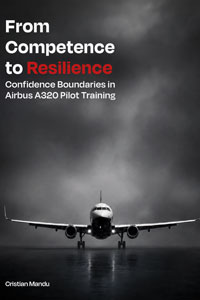
This question underpins the doctoral research of Airbus A320 captain Cristian Mandu, presented in his dissertation From Competence to Resilience: Confidence Boundaries in Airbus A320 Pilot Training. His research explores the cognitive foundations that enable pilots to deploy their competencies in demanding conditions.
Training for the Realities of Human Performance
Evidence-Based Training (EBT), widely adopted by airlines, trains and assesses pilots using a set of competencies and associated observable behaviors. Yet existing frameworks largely overlook the cognitive and psychological mechanisms that drive and sustain those behaviors under pressure.
Across four empirical studies involving A320 pilots, instructors, and examiners, Mandu investigated simulated ABN/EMER scenarios. His research informs two complementary training pathways: cognitively economical tools designed to remain usable despite foreseeable reductions in cognitive capacity during specific challenges; and a failure-agnostic five-step management structure applicable across ABN/EMER scenarios. Both aim to help pilots move from scrambled, reactive trial-and-error responses towards tactical control guided by a clear plan.
Robustness - Competence - Resilience
To complement EBT, Mandu proposes Confidence-Based Robustness Training (CBRT), a bottom-up framework that starts with the situations pilots report as most threatening to their performance and confidence. These situations are deconstructed into their constitutive building blocks: trainable operational challenges that define pilots' confidence boundaries.
CBRT seeks to strengthen robustness at these boundaries, enabling adaptivity when challenges recombine in novel situations. From a Cognitive Systems Engineering perspective, robust and adaptive pilots may more effectively contribute to the resilient performance of the wider sociotechnical system, including in unforeseen situations beyond design boundaries.
By addressing the cognitive and psychological mechanisms that drive and sustain competent performance under pressure, CBRT seeks to support EBT's overarching objective: enabling pilots trained in a finite set of competencies to manage unforeseen situations for which they have not been specifically trained. In doing so, CBRT aims to strengthen the individual pilot’s contribution to system-level resilient performance.
About the Researcher
Cristian Mandu (Bucharest, 1979) is an Airbus A320 captain at Etihad Airways, an EASA A320 instructor and examiner, and a Crew Resource Management trainer.
He will defend his dissertation on 19 November 2026 at 13:30 at the Faculty of Management of the Open Universiteit in Heerlen. His promotor is Prof. Dr. Petru Lucian Curșeu and his copromotor is Dr. Alexander Henkel, both at the Open Universiteit.
The defense can be attended in Heerlen or followed at ou.nl/live.