How AI helps us listen even better to the universe
Ripples in spacetime
Gravitational waves are produced by extreme cosmic events, such as collisions between black holes and neutron stars. They cause tiny ripples in spacetime, which are measured with extremely sensitive detectors. As these detectors become more advanced, disturbances also increase. These short, unpredictable noise signals, known as glitches, can mimic or mask real gravitational waves.
What does normal background noise sound like?
Dooney developed AI methods that learn what the normal background noise of detectors looks like. Anything that deviates from this can then be automatically recognised and separated from the normal background. This allows researchers to better isolate and study both astrophysical events, such as binary black hole mergers, and unknown or difficult-to-model signals, including glitches. The research also shows that generative AI can be used to simulate realistic gravitational-wave signals and glitches. These simulations offer new possibilities for testing and improving detectors and analysis methods.
Einstein Telescope
With the expected arrival of next-generation observatories, such as the Einstein Telescope, which may be able to detect hundreds of events per day, traditional analysis methods are becoming increasingly difficult to scale due to their computational costs and reliance on detailed signal models. This research aims to contribute to the development of faster, more flexible tools that can reliably separate real astrophysical signals from noise, even when those signals are unknown or overlap with glitches. The dissertation shows that deep learning methods enable cleaner and more robust gravitational-wave measurements and can help prepare the field for the expected data flow in gravitational-wave astronomy with next-generation detectors like the Einstein Telescope: Europe’s most advanced gravitational-wave observatory that may be hosted in Limburg.
An important advantage of the new approach is that glitches can be removed without the algorithm needing to know in advance what they look like. The method learns only the normal behaviour of detector noise. When this predicted noise is subtracted from the measurement data, both the disturbances and the gravitational-wave signals remain visible. This makes it possible to also discover signals from previously unknown cosmic sources.
About Tom Dooney
Tom Dooney (Dublin, 1995) began his PhD research in January 2022. This year, he started a postdoctoral research position at Nikhef. He obtained a BSc in Theoretical Physics from University College Dublin in 2018 and an MSc in Data Science from Maastricht University in 2021.
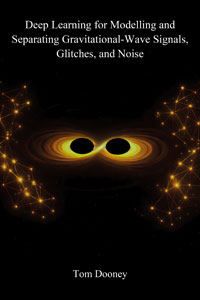
On Thursday, 26 February 2026, at 4.00 PM, he will defend his dissertation, entitled 'Deep Learning for Modelling and Separating Gravitational Wave Signals, Glitches, and Noise', at the Open University in Heerlen.
The dissertation was supervised by Dr. Stefano Bromuri (Open Universiteit), Prof. Dr. Chris van den Broeck (Utrecht University), Dr. Daniel Tan (Open Universiteit) and Dr. Lyana Curier (Open Universiteit).
The defence can also be followed online via ou.nl/live.