
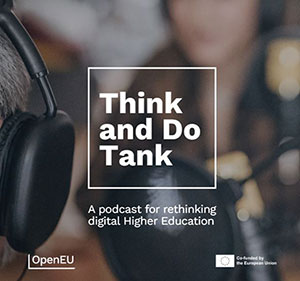
OpenEU launches new podcast series to rethink the future of Higher Education
Across eight episodes, the podcast brings together leading experts to move beyond surface-level adoption and identify the concrete actions and essential conditions needed for digital innovation to truly work in higher education.
Episode 1: Has Digital Transformation changed pedagogy?
In the first episode, host Haline Maia (Universidade Aberta, Portugal) is joined by two distinguished guests to tackle the central tension in modern education: 'Technology is moving fast. Is pedagogy moving too?'. Although digital tools are now mainstream, many institutions still rely on traditional approaches—such as using digital platforms for assessments designed for face-to-face settings with little room for collaboration. During the episode, Haline Maia discusses virtual mobility, institutional barriers, and embracing AI with her guests. Listen to the first episode to learn more about their views.
Meet the guests
Prof. dr. Paquita Pérez Salgado: Full Professor of Online and Distance Education in Environmental Sciences at the Open Universiteit. A former UNESCO Chair, she has decades of experience in developing innovative higher education programmes with a focus on sustainability and 'Lived Experience of Climate Change'.
Prof. Wim Van Petegem: Professor at the Faculty of Engineering Technology at KU Leuven (Belgium) and President of EDEN Digital Learning Europe. His work focuses on instructional design and engineering education, and he is deeply involved in digital competence training across the Global South.

Funded by the European Union. Views and opinions expressed are however those of the author(s) only and do not necessarily reflect those of the European Union or the European Education and Culture Executive Agency (EACEA). Neither the European Union nor EACEA can be held responsible for them.