From experiment to everyday practice: Virtual Reality in higher education
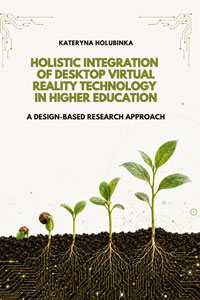
Kateryna Holubinka will defend her thesis 'Holistic Integration of Desktop Virtual Reality Technology in Higher Education: A Design-Based Research Approach' on Thursday 18 June 2026 at 4.00 pm at the Open University in Heerlen.
Promising pilots
Much educational technology appears promising in pilot projects, but only a small proportion proves successful in practice. This also applies to the use of Virtual Reality (VR), which is often temporary, experimental and insufficiently aligned with standard curricula and teaching processes.
Desktop virtual reality
How can we make VR a success in education? In her research, Holubinka focuses on Desktop VR which, via a computer screen and without head-mounted displays, can be easily connected to educational infrastructure such as video conferencing platforms. Desktop VR provides three-dimensional visual explanations, displays dynamic perspectives and supports teachers’ presentations virtually.
What is needed for meaningful integration?
Holubinka identifies five interrelated dimensions that are important for the smart integration of Desktop VR into educational practice: technology, pedagogy, context, values and management. For instance, teachers need pedagogical reasons to use virtual environments. For example: to explain spatial structures, to show inaccessible places or to enhance the teacher’s presence in online education. At the same time, institutions must take practical conditions into account, including hardware, software integration, teacher training, support, accessibility, privacy and long-term evaluation.
A framework and three templates
Holubinki developed a so-called HITE framework that helps educational institutions to incorporate the five dimensions mentioned above when integrating Desktop VR. And to view it as a well-considered process of designing, evaluating, adapting and supporting.
In addition, she developed three technology-specific instructional templates for VR-enhanced presentations: a slide presentation, a 3D model presentation and a virtual environment. These demonstrate that selective use of Desktop VR is preferable. Using a 3D model presentation to rotate an object, zoom in on details, and draw attention to spatial relationships is effective. However, too many effects, movements or background details are distracting. The added value of Desktop VR therefore lies not in making education more spectacular, but in supporting clear, targeted explanations where visual or spatial understanding is important.
About Kateryna Holubinka
Kateryna Holubinka (Luch, Ukraine, 1988) obtained a Master’s degree in Foreign Language Learning and Literature Studies from Kyiv National Linguistic University (Ukraine) and a Master’s degree in Education, Media and E-learning from FernUniversität in Hagen (Germany).
She will defend her thesis 'Holistic Integration of Desktop Virtual Reality Technology in Higher Education: A Design-Based Research Approach' on Thursday 18 June 2026 at 4.00 pm at the Faculty of Behavioural and Health Sciences of the Open University in Heerlen.
Her supervisors are Prof. Renate de Groot (on behalf of the Open University) and Prof. Roland Klemke (Open University; TH Köln). Co-supervisors are Dr Corrie Urlings (Open University) and Dr Giel van Lankveld (Open University). The defence can be attended in person at the Open University in Heerlen or followed online via ou.nl/live.