Inaugural lecture by Stefano Bromuri: humans must have final say on AI
AI has radically changed software development. AI copilots and agents can support developers throughout almost the entire software lifecycle: from assessing feasibility and defining requirements to proposing designs, programming, testing and maintenance.
At the same time, software developed using AI increasingly incorporates AI itself. These systems interpret information, learn from data, make recommendations, plan actions or collaborate with other systems. As a result, their behaviour is no longer determined solely by source code, but also by data, learning processes, interactions and the environment in which they operate.
Like a pen that writes about itself
Through his Chair in Software Engineering and AI, Stefano Bromuri brings these two strands together, creating an intriguing interplay. 'The AI tool that helps us design a software system becomes part of that system itself.' Bromuri compares it to a pen that writes about itself. Hence the title of his inaugural lecture: Software Engineering and AI: How to Make a Pen Write About Itself.
Human control
'A central question in my research is how we can design software systems that reason, learn and improve themselves, while remaining within clear boundaries and under human oversight. We consider questions such as: where should intelligence be placed within the software architecture? What information should an AI component be allowed to perceive, and what should remain beyond its reach? How should different AI agents work together? How can we scrutinise decisions, and who is responsible when something goes wrong?'
Bromuri is particularly interested in representation learning: the way in which an AI system organises information internally. 'A system needs internal representations of its environment, the problem it is solving and the possible actions it can take. My research focuses on how these representations can support reasoning and how software systems can independently improve parts of their own structure, instructions, rules and workflows. This must be done systematically, without compromising safety, reproducibility or human control.'
More than an accurate prediction
According to Bromuri, these research questions are more urgent than ever, given the use of AI in healthcare, logistics, energy supply, scientific infrastructure, public services and everyday work. In these fields, an accurate prediction alone is not enough. The entire software system must be reliable, understandable, safe and easy to scrutinise.
AI systems can also produce incorrect information, behave unpredictably, amplify bias, disclose sensitive data or act beyond their intended responsibilities. In some cases, it becomes difficult to establish why a particular decision was made.
Deploying multiple collaborating AI agents does not automatically solve these problems. On the contrary, it can create more opportunities for errors. Responsibilities, boundaries, checks, logging, approval procedures and human oversight must therefore be incorporated into the design from the outset, rather than being added afterwards.
The importance of critical thinking
Through his research, Bromuri aims to contribute methods for developing AI systems that are powerful and flexible, but also transparent, testable and socially responsible. Human agency and responsibility must be preserved.
This approach is also reflected in his teaching. According to Bromuri, future software engineers must understand that working with AI is a fully fledged engineering activity. 'They must use AI creatively without losing sight of the importance of mathematical knowledge, evidence, verifiability and critical thinking.'
Ultimately, Bromuri aims to develop software engineering and AI into a single, coherent field. The goal is to 'design systems that can reason, learn and improve themselves, while remaining understandable and easy to scrutinise for the people who work with them'.
About Stefano Bromuri
Stefano Bromuri (born in Cesena, Italy, in 1982) has been affiliated with the Open Universiteit since 2016. He began as an Assistant Professor of Data Analytics and became an Associate Professor in 2022. Since 1 January 2025, he has been Professor of Software Engineering and Artificial Intelligence at the Faculty of Science.
Bromuri studied computer engineering and ICT engineering at the University of Bologna and obtained his PhD from Royal Holloway, University of London, in 2009. In addition to his work at the Open Universiteit, he works at DHL Express on applications involving AI and machine learning.
Practical information
Stefano Bromuri will deliver his inaugural lecture, Software Engineering and AI: How to make a pen write about itself, on Friday 6 November 2026 from 4.00 pm to 5.00 pm at the Open Universiteit in Heerlen. The lecture can be viewed in full at ou.nl/live. You can register for the lecture and the symposium via ou.nl/uitnodiging.
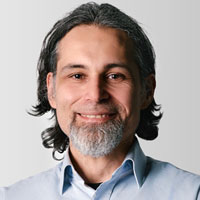
Prof. Dr. Stefano Bromuri